
Mary Kawena Pukui’s ‘0lelo No‘eau: Hawaiian Proverbs and Poetical Sayings (Bishop Museum Press 1983) Selected by Melenani Lessett.
Ke kai lipolipo polihua a Kane (1729). "The dark-blue ocean of Kane." The deep sea out of sight of land. Ka manu kahea i ka wa'a e holo (1478). "The bird that calls the canoe to sail." Said of the kioea (bristle-thighed curlew), whose early morning call was often a signal to canoes to go fishing or traveling. Eia no kahi koe o ka moamoa (306). "Here is the only space left, the moamoa (a projection at the stern of the canoe)." Said when offering a small space or seat to someone, when every other space is occupied. (From the story of Pa'ao, who offered the moamoa to Makuaka'umana, a priest, on a voyage from Kahiki to Hawai'i. Makuaka'umana leapt from a cliff and landed on the moamoa; thus, he was able to sail to Hawai'i.) Ha'ule i ka hope wa'a (489). "Left in the aft of the canoe." Said of one who comes last or is tardy. E pane'e ka wa'a oi moe ka 'ale (371). "Set the canoe moving while the billows are at rest." Said by Holowae, a kahuna, to suggest that Kalani'Opu'u return to Hawai'i while there was peace. Later used to stir one to action. Ha'alele koa wa'a i koa kanaka (398). "The koa canoe has departed, leaving the warriors behind." Said when a canoe goes off and leaves the people behind. 'Au i ke kai me he manu ala (237). "Cross the sea like a bird." To sail across the sea. Ola i ke ahe lau makani (2483) "Life is in a gentle breath of wind." Said of a breeze on a hot day.
E lauhoe mai na wa'a; i ke ka, i ka hoe; i ka hoe, i ke ka; pae aku i ka 'aina (327) "Everybody paddle the canoes together; bail and paddle, paddle and bail, and the shore will be reached."If everybody pitches in, the work is quickly done. He ma'uka'uka hoe hewa (809). "A person from the uplands, unskilled in paddling." He po'e ho'opiha wa'a (897) "Canoe fillers." Useless people, like riders in a canoe who do nothing to help. Ka manu ka'upu halo 'alo o ka moana (1479). "The albatross that observes the ocean." A careful observer. Ua ho'i ka noio 'au kai i uka, ke 'ino nei ka moana (2787). "The seafaring noddy tem has returned to land, for a storm rages at sea." A weather sign. Lele ka 'iwa malie kai ko'o (1979). "When the frigate bird flies out to sea, the rough sea will grow calm." A weather sign.
'A'ohe wa'a ho'ohoa 0 ka la 'ino (216). "No canoe is defiant on a stormy day." E ho'i ka wa'a; mai ho'opa'a aku i ka 'ino (286). "Make the canoe go back; don't insist on heading into a storm." He ho'okele wa'a no ka la 'ino (592). "A steersman for a stormy day." A courageous person. Kihe ka ihu i ka 'ale (1789). "One who sneezes when the spray from the surf rises at the bow of the canoe." Said of one who braves danger with indifference. Mai ka ho'okui i ka halawai (2059). "From zenith to horizon." Expression in prayers to the gods, calling them from everywhere.
E 'ike ka hoku o ka nalu, o hoku 'ula, o hoku lei "Behold the stars of the waves, the red star, the wreath of stars." When the rising and setting stars are near the ocean horizon, they provide clues to direction. [From a chant in the story of Paka'a and Kuapaka'a.] He hewa i Kapua ka 'auwa'a panana 'ole (1125) "The fleet of canoes without a compass landed at Kapua by mistake." Said of one who is off his course, mentally or otherwise.
He kau auane'i i ka lae 'a'a (677). "Watch out lest the canoe land on a rocky reef." Pae mai la ka wa'a i ka 'aina (2566). "The canoe has come ashore." Hunger is satisfied; desire fulfilled. 'A'ohe hana a Kauhikoa; ua kau ka wa'a i ke 'aki (139) "Kauhikoa has nothing more to do; his canoe is resting on the block." The work is done. |

 Hu ka makani (1133) "The winds roars." Said of great speed.
 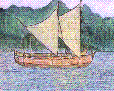 Poho pono na pe'a heke a ku ana (2681). "A full sail helped him to arrive." Said of a fast traveler.
  Komo mai kau mapuna hoe (1836). "Dip your paddle in." Join in the effort.
  Ho'okahi ka 'ilau like ana (1068). "Wield the paddles together." Work together.
  He noio 'a'e 'ale no ke kai 1oa (844). "A noddy tern that treads over the billows of the distant sea." An expression of admiration for a person outstanding in wisdom and skill.
  Ulu o ka la (2870). "The sun grows." Said of the light of sunrise just as the sun's rim touches the horizon. The morning sun is used for navigation to determine the primary direction of east.
  0 na hoku no na kiu o ka lani (2513). "The stars are the eyes of heaven." The stars secretly observe all.
  Aia ke ola i Kahiki (58) "Life is in Kahiki." Life and prosperity are in the care of the gods [The gods are said to reside in Kahiki.]