 |
|
1992 Voyage: Sail to Rarotonga Dennis Kawaharada (Photos Below by Moana Doi; Photo right: Stones brought in commemoration of the gathering of canoes gather at Vaka Village, Rarotonga, 1992)
The first island stop was Mauke, the home of Pe`ia Tua`ati, one of the seven Cook Island navigators who had joined the Hokule`a crew in Ra`iatea. About 400 miles southwest of Borabora, Mauke is the closest of the Cook Islands to the Society Islands. It took the canoe three days in light winds to reach the island, recreating the voyage of settlement to the island sometime in the 13th century by an ancestor named Uke, who arrived at Mauke from the homeland of `Avaiki, or Ra`iatea, in a canoe named Apaipai-moana. Maile, the fragrant leafy vine from which leis are made, grows abundantly in the rich red volcanic soil of this small, low, wooded island. The island is the source of the favored Cook Islands maile sold in Hawai`i.
The welcome ceremony and feast on Mauke took place in two shifts. Half of the crew landed in the morning while the other half sailed the canoe back and forth outside the reef. The two crews switched places in the afternoon. On shore, the crew was taken to a narrow freshwater pool in an underground coral cave, where they swam and washed the salt from their sun-baked bodies. After spending September 23 off Mauke, Hokule`a headed for Aitutaki, 160 miles northwest of Mauke. On the two-day voyage, it passed the island homes of two other Cook Islander navigators who had joined the Hokule`a crew in Ra`iatea: Mitiaro, home of Nga Pou`a`o; and Atiu, home of Tura Koronui. Aitutaki, the northernmost of the Southern Cook Islands, is the home of two other Cook Islander navigators-Clive Baxter and Dorn Marsters. For these two Hokule`a crew members, the voyage from Ra`iatea to Aitutaki was a recreation of the original voyage of discovery and settlement of their island. According to tradition, Aitutaki was settled from `Avaiki, or Ra`iatea, by the chief Ru`enua. Seeing that his district in Ra`iatea was becoming overpopulated, Ru gathered his family and announced that he had selected a star under which he was sure he could find a new home for them. With his family and twenty young women who would become the mothers of the new island, Ru launched his canoe toward the undiscovered island. The canoe was paddled. On this voyage Ru's canoe encountered some of the dangers traditionally associated with voyaging in the Pacific: a whirlpool, a waterspout, a submerged rock, and a three-day storm at sea that hid his guiding star from him. Ru prayed for help to Tangaroa, the Lord of the Ocean: O Tangaroa in the immensity of space, The sky cleared and his star appeared. He made landfall on Aitutaki. The name of his canoe was Te Puariki. In honor of that canoe, the Aitutaki canoe, completed in 1992, was named Ngapuariki.
Rarotonga was once an island which floated about on the Sea of Rank Odors, which is to say, its location was uncertain. The god Tonga`iti and his wife Ari discovered it; Tonga`iti trod upon it to make it firm, and Ari dove beneath it to fix its foundation. Later, after they were tricked out of their claim of discovery, Tonga`iti turned into a mo`o, or lizard, and Ari into a he`e, or octopus. Tangiia, one of the human ancestors of the Rarotongans, was a famed voyager. Tangiia is said to have come from Tahiti during the thirteenth century. In Tahiti he and his half-brother Tutapu quarreled over the harvest of breadfruit and other rights belonging to their father. After being defeated in battle, Tangiia fled Tahiti, pursued by his brother, who earned the name Tutapu-the-relentless-pursuer. During his flight, Tangiia was said to have sailed to Indonesia in the west and back to Rapanui, or Easter Island, in the east, an ocean expanse of over 10,000 miles. Tutapu finally caught up with Tangiia in Rarotonga. Tangiia slew him. Tangiia settled in Rarotonga which had already been settled by Marquesans and Tongans. Karika, a Samoan, settled in Rarotonga about the same time as Tangiia, but the Tahitian culture seems to have predominated, and temples, including a Taputapuatea, were established on the island. Tangiia is the founder of the Pa-ariki line of chiefs ruling the district of Takitumu on Rarotonga. A canoe left from Takitumu in the 14th century to settle in Aotearoa. The Rarotongan sailing canoe, built under the leadership of former prime minister Sir Tom Davis for the 1992 Festival of Pacific Arts, was given the name Takitumu. Sails to Rarotonga: To celebrate the revival of voyaging in the Pacific, Hokule`a and fifteen other Pacific Island canoes converged on Rarotonga to participate in an historic vaka, or canoe, pageant. This pageant, held on October 21, was the culminating event of the sixth Festival of Pacific Arts, which celebrated the seafaring heritage of the Pacific Islanders.
From the island of Atiu came the canoe Enuamanu, navigated by Tura Koronui. From the island of Mitiaro came the canoe Te Roto Nui, navigated by Nga Pou`a`o. From the island of Mauke came the canoe Maire-nui, navigated by Pe`ia Tua`ati. These three canoes sailed together from Atiu, 116 miles to the northeast of Rarotonga. From the island of Mangaia, 110 miles to the southwest of Rarotonga, came the canoe Rangi-Ma-Toru, navigated by Ma`ara Tearaua. From Aotearoa came the Maori canoe Te Aurere. It crossed 1500 miles of cold, stormy seas, with gale force winds. On board was an eleven-man crew led by Stanley Conrad, along with Mau Piailug, the Satawalese navigator, and Hawaiian Clay Bertelmann, Hokule`a's kapena from Hawai`i to Tahiti. The canoe arrived in Rarotonga a day after the vaka pageant, on October 22, over three weeks after departing from Taipa Beach north of Auckland. Despite broken masts and booms, one capsizing, and one search and rescue operation, all the canoes and crews made it safely to Rarotonga-a tribute to the courage and skill of the people involved on the canoes and escort boats, and their determination to revive the arts of canoe-building and voyaging in the Pacific.
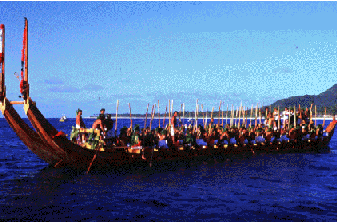
The Vaka Pageant: On October 21, sixteen Pacific Island vaka, or canoes, entered one by one into Avana Harbor in Muri Lagoon, on the southeast coast of the island of Rarotonga. As the visiting canoes entered the lagoon, they were met by two Rarotongan canoes, the sailing canoe Takitumu and the war canoe Uri Taua. Along with Hokule`a were six Cook Islands canoes, a Marshallese canoe (photo left, by Moana Doi), a New Caledonian canoe, a Papua-New Guinean canoe, a Maori war canoe (photo left below, by Moana Doi), two Tahitian sailing canoes, and Te Rauroa o Hiva, a six-man Tahitian canoe which had been paddled over 600 miles of open ocean in 10 days, from Ra`iatea to Rarotonga, with a stop on Mauke. Tahitian Pito Clement and his five paddlers had made the journey to recreate the ancient voyage of Tangiia, one of the founders of Rarotonga.
The arrival of each canoe was announced by the beating of drums and the blowing of pu, or conch shells, Hokule`a arrived last. On shore, protocol officer Keone Nunes responded to the traditional challenge with a chant announcing the canoe's peaceful purpose: "We`ve come to re-contact families we have not seen for many generations," he told the Rarotongans. The crew was then welcomed with shouts of "turou" ("honor to you") and "oro mai" ("come forward"). Each canoe arrived with a stone from its home island; the stones were set on a circular mound to commemorate the coming of the canoes in 1992. Hokule`a's stone came from Niu valley, the home of sailmaster Nainoa Thompson and his father Myron Thompson, the President of the Polynesian Voyaging Society. Nainoa spoke movingly about the signficance of the pageant: "The Vaka Pageant is a bridge between the past and the future," he said. "One end of the bridge stands at Muri Lagoon, from which the ancestors of the New Zealand Maori sailed to their present home 600 years ago. We stand in the middle of the bridge, with the other end in the 21st century. We come from the greatest explorers on the face of the earth. The same principles of exploration our ancestors followed in the past must carry Pacific people forward, exploring, discovering, and taking on the challenges of time."
In 1977, Pi`ianai`a planned a sail to recreate the traditional Hawaiian departure to Tahiti-not northeast from the islands to gain easting, the route taken in 1976, but southeast, across the Kealaikahiki Channel between Lana`i and Kaho`olawe and past Kealaikahiki Point on west end of Kaho`olawe. Kealaikahiki means "The Way to Tahiti." On an eerie morning, with light winds, Hokule`a left Manele Bay on Lana`i. Once it passed Kealaikahiki Point and entered the `Alenuihaha Channel it caught the tradewinds and headed south for two days, then returned to Hawai`i. On subsequent voyages to Tahiti, Hokule`a would depart on the traditional southeastly course. Pi`ianai`a first served as Kapena of Hokule`a in 1977 during educational interisland voyages, which brought the canoe to Hawai`i's schoolchildren for the first time. He served again as Kapena on the 1980 voyage to Tahiti and back. During the 1985-87 Voyage of Rediscovery, when Hokule`a sailed for the first time from east to west through Polynesia, Pi`ianai`a served as Kapena from Tahiti to the Cook Islands. It was during this voyage that the revival of ancient sailing traditions spread to the Cook Islands and Aotearoa. For Kapena Pi`ianai`a, one of the highlights of the 1992 Voyage of Education was witnessing the fruits of this Hokule`a-inspired revival: as each canoe arrived at Rarotonga, it was greeted by a crowd of home islanders, who chanted and sang greetings and praises. Another highlight for the Kapena was the performance of his crew, both Hawaiians and Cook Islanders, who displayed knowledge, skill, and character in caring for and sailing Hokule`a. CREW MEMBERS (As of August, 1992): BORABORA - COOK ISLANDS, 1992: Nainoa Thompson, Sailmaster; Chad Baybayan, Navigator; Gordon Pi`ianai`a, Captain; Moana Doi, Photo-documentator; John Eddy, Film Documentation; Ben Finney, Scholar; Wally Froseith, Watch Captain; Brickwood Galuteria, Communications; Harry Ho; Ka`au McKenney; Keahi Omai; Keone Nunes, Oral Historian; Billy Richards, Watch Captain; Cliff Watson, Film Documentation; Cook Islands Crew Members: Clive Baxter (Aitutaki); Tura Koronui (Atiu); Dorn Marsters (Aitutaki);Tua Pittman (Rarotonga); Nga Pou`a`o (Mitiaro); Ma`ara Tearaua (Mangaia); Pe`ia Tua`ati (Mauke). |
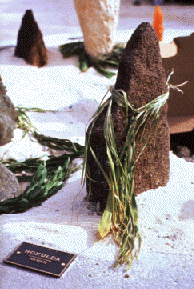 Landing at Mauke: After being towed from Ra`iatea to Borabora, Hokule`a sailed from Borabora for the southern Cook Islands on September 20, under the command of Kapena Gordon Pi`iana`ia, navigator Chad Baybayan, and sailmaster Nainoa Thompson.
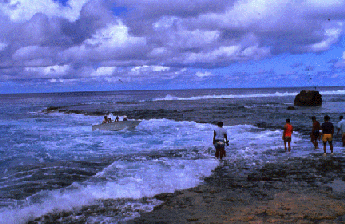 There is no harbor or anchorage on Mauke. In order to land, Hokule`a's crew had to be brought to shore five members at a time in an aluminum motor boat. The boat had to ride a surging wave through the narrow opening of a sandy-bottomed, key-hole-shaped break in the fringing reef, then power across the swirling, churning basin, and up onto the reef, where the passengers scrambled off and waded to shore as the wave receded (Photo by Moana Doi). In order to get back out to the canoe, the boat had to be launched on the backwash of a wave and ride the surge across the basin and out through the narrow opening.
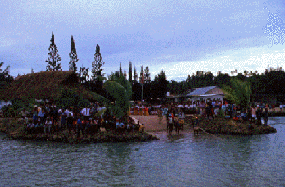 After docking at a newly built marina on Aitutaki (photo by Moana Doi) on September 25, the Hokule`a's crew settled into the Mission House at Arutanga village in Aitutaki . They had a wait of three weeks before the canoe would sail to the island of Rarotonga to participate in the 6th Pacific Festival Arts.
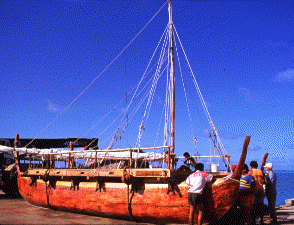 On October 15, with easterly winds of 10 knots, Hokule`a left Aitutaki, along with Ngapuariki, the Aitutaki canoe (photo left, by Moana Doi), navigated by Clive Baxter and Dorn Marsters; Te Kotaa-nui, a two-man sailing canoe; and Waan Aelon Kein, a six-man, 50-foot Marshallese walap canoe. Rarotonga was 140 miles to the south. Hokule`a was navigated by Rarotongan Tua Pittman, who had sailed with the canoe during the 1985-87 Voyage of Rediscovery and who was host to Hokule`a's crew on his home island of Rarotonga in 1992. Then,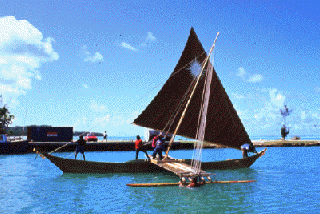
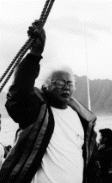 Kapena Gordon Pi`ianai`a: Hokule`a's Kapena for the sail from Huahine to Rarotonga in 1992 was Gordon Pi`ianai`a, director of the Hawaiian Studies Institute at Kamehameha Schools. Kapena Pi`ianai`a first sailed on Hokule`a in 1976 as first mate on the return voyage to Hawai`i. His charge from the Polynesian Voyaging Society Board was to bring Hokule`a home from Tahiti safely.